Rack Repair vs. Rack Replacement: How to Make the Right Call (and Stay OSHA Compliant)
Key Takeaways
- Forklift impact is the leading cause of pallet rack damage — and most operations discover damage during routine visual checks, not structural failures. What you do next determines whether it’s a minor cost or a major liability.
- ANSI/RMI MH16.1-2023 is the governing standard for rack repair and replacement in the U.S. The decision to repair vs. replace must be consistent with this standard, not based on cost alone.
- Damaged upright columns should almost never be field-straightened or welded — field modification of load-bearing columns is specifically not recommended by RMI and typically voids the manufacturer warranty.
- Engineered column repair kits are a legitimate and cost-effective option for minor upright damage — when properly assessed and installed. They are not a substitute for replacement of severely damaged components.
- Three things that must happen immediately after any forklift impact: take the affected bay out of service, document the damage with photos, and get a qualified assessment before reloading.
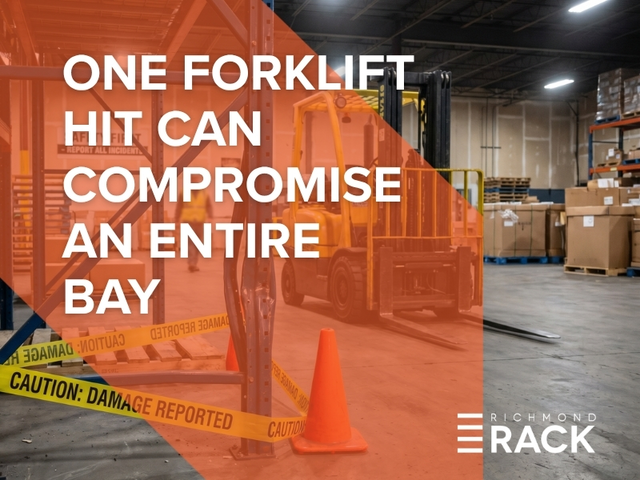
A forklift clips a rack upright. The operator checks for fallen pallets, sees the damage looks minor, and continues the shift. By the end of the day, the incident is forgotten. The rack is still loaded.
This is the most common pattern that precedes a rack collapse. The damage was real. The assessment never happened. The decision between repair and replacement was never made.
The Rack Manufacturers Institute (RMI) estimates that the majority of rack failures involve components that were damaged — often by forklift impact — and returned to service without a qualified inspection. The structural consequence of a dented upright isn’t always visible from the aisle. A small dent can reduce load capacity by 20 to 50 percent depending on its location and depth.
This guide covers how to assess rack damage, when repair is appropriate, when replacement is required, and what OSHA and ANSI/RMI MH16.1 actually require from your operation.
The Governing Standard: ANSI/RMI MH16.1-2023
ANSI/RMI MH16.1-2023 — “Design, Testing, and Utilization of Industrial Steel Storage Racks” — is the primary engineering standard for pallet racking in the United States, published by the Rack Manufacturers Institute. OSHA references this standard when evaluating warehouse racking during inspections and enforcement actions under the General Duty Clause.
Key requirements relevant to damage assessment and repair:
- Owners are responsible for maintaining the structural integrity of installed rack systems through regular inspection and maintenance
- Any damaged rack component must be evaluated by a qualified person before the system is returned to full service
- Repairs must restore the rack to compliance with ANSI MH16.1 requirements — not just cosmetically, but structurally
- Load capacity plaques must be updated if the rack configuration changes as part of any repair or replacement work
- Engineering documentation for the original installation is required to properly evaluate repair options — if not available, a supervising engineer must develop new calculations
OSHA penalties for serious racking violations range from $15,625 to $156,259 per violation for willful or repeat citations — before any civil liability from a rack-related injury. (OSHA warehousing enforcement)
How to Assess Rack Damage: A Practical Inspection Framework
Immediate response after any forklift impact
Before any assessment, three things must happen immediately:
- Take the affected bay out of service — remove load and barricade the area before any inspection
- Document the damage with photographs from multiple angles, including the full upright height and the anchor point
- Do not return the bay to service until a qualified assessment has been completed
“It looks minor” is not an assessment. Visual appearance of upright damage is an unreliable indicator of structural capacity reduction.
What to inspect and what to look for
Upright columns — the most critical component. Inspect the full height of both columns in the affected frame for dents, bends, cracks, and weld damage. Pay particular attention to the area 6–18 inches above the floor (the most common impact zone) and the connections to diagonal bracing. A dent exceeding approximately 1 inch of deformation per 36 inches of column height is generally considered to require replacement or engineered repair, but this must be evaluated by a qualified person — not estimated by eye.
Beam end connectors — check that locking pins are intact and fully engaged. Stretched, deformed, or missing connectors are a serious safety issue. A beam with a compromised connector can disengage under dynamic load — particularly during forklift retrieval operations.
Diagonal and horizontal bracing — inspect for bends, cracks, and loose or damaged welds at connection points. Bracing provides the frame’s lateral stability. Damaged bracing significantly reduces the upright’s ability to resist horizontal loads from forklift impact.
Base plates and anchors — confirm that anchor bolts are intact and the base plate is flat against the floor. A pulled or bent anchor is a replacement item. Racking that isn’t properly anchored is non-compliant under ANSI MH16.1 regardless of the condition of other components.
Repair vs. Replacement: The Decision Framework
| Damage Type / Situation | Repair Option | Replace Option |
| Upright column — minor dent, no buckling | Engineered column repair kit (bolted) | Replace if >1″ deformation per 36″ height |
| Upright column — bent, buckled, or cracked | Not repairable — replace immediately | Replace full upright frame |
| Beam — minor end connector damage | Replace connector/pin; inspect beam | Replace beam if connector is deformed |
| Beam — bent or deflection exceeds limits | Not repairable — replace beam | Replace beam; inspect adjacent uprights |
| Diagonal/horizontal brace — damaged | Engineered repair in some cases; consult engineer | Replace if welded connection is compromised |
| Base plate — damaged or pulled anchor | Re-anchor with engineered anchors | Replace base plate if cracked or deformed |
| Wire decking — bent or missing wires | Replace individual decking panels | Replace section if structural wires are damaged |
| Load plaque — missing or outdated | N/A — update and reinstall immediately | N/A — always required; update on any config change |
The single rule that overrides all others: if you are uncertain whether a component is structurally adequate, take it out of service and get a qualified engineering assessment before reloading. The cost of an inspection is a fraction of the cost of a collapse.
When engineered repair kits are appropriate
Column repair kits — also called upright repair kits — are bolted structural reinforcements designed to restore the load capacity of a mildly damaged upright column. They are a legitimate option under ANSI MH16.1 when the damage is minor and confined, when the repair kit is engineered for the specific upright profile and load requirements, and when installation is performed by a qualified person.
Repair kits are not appropriate for: columns with visible cracks or buckles; columns with damage near base plates or bracing connections; any situation where original engineering documentation isn’t available to confirm the repair restores compliance; or when the cost of multiple repair kits across a damaged section approaches the cost of replacement.
stocks repair kits, replacement uprights, beams, and guardrail for immediate availability — reducing the lead time between damage assessment and corrective action. Our installation team performs post-repair safety inspections to confirm compliance before bays are returned to service.
When to replace, not repair
Replacement is required — not optional — in these situations:
- Any upright column with a bend, buckle, or crack in the load-bearing section
- Any column where field straightening or welding has been attempted — field modification of load-bearing rack columns is specifically not recommended by RMI and typically creates additional compliance issues
- Any component where the damage extent can’t be fully assessed without disassembly
- Any frame where the cumulative damage across multiple components makes repair impractical or where the repair cost approaches replacement cost
- Any situation where original engineering documentation is unavailable and a supervising engineer determines the component doesn’t meet current ANSI MH16.1 requirements
The Inspection Schedule ANSI MH16.1 Recommends
A compliant rack inspection program has three tiers:
Daily visual checks — forklift operators and warehouse personnel should visually scan rack in their work areas each shift. The goal is catching fresh damage from overnight or morning operations before it gets buried under product.
Monthly documented inspections — a trained warehouse employee walks every rack aisle with a documented checklist, records any damage observed, and flags items for engineering review. These records should be maintained for a minimum of five years.
Annual professional inspection — a qualified rack engineer or RMI-certified inspector conducts a full structural assessment of the installed system, verifies load plaques are current and correctly posted, confirms anchoring compliance, and documents the system’s condition. This is the inspection that catches what daily and monthly visual checks miss — and is the basis for any repair or replacement decisions.
Richmond Rack’s sister company PeakLogix provides formal rack inspection and preventative maintenance programs as part of its Lifetime Services offering — including racking assessments, load compliance verification, and repair or replacement recommendations.
Load Plaques: The Requirement Most Operations Get Wrong
ANSI MH16.1 requires load capacity plaques to be conspicuously posted at the end of every rack aisle, reflecting the actual engineered load limits for the specific configuration installed — not the manufacturer’s maximum theoretical capacity, and not a generic sign.
A 2023 survey cited by ACE Racking found that 34% of distribution centers had incomplete or missing load plaques — one of the most common OSHA citation items during warehouse inspections. Any repair or replacement that changes the rack configuration requires updated load plaques before the system is returned to service.
Need Replacement Components or a Damage Assessment?
Richmond Rack stocks replacement uprights, beams, wire decking, repair kits, and guardrail for immediate delivery — reducing the window between identifying damage and correcting it. We carry Steel King, Ridg-U-Rak, SpaceRak, Interlake, and Elite components for both new and legacy systems.
Browse our racking inventory, request a quote, or contact our team to discuss compatibility with your existing system. For formal rack inspections and engineered repair programs, PeakLogix’s preventative maintenance team provides comprehensive racking assessments throughout Virginia and the mid-Atlantic region.
→ Contact Richmond Rack for components, quotes, or installation support.
Frequently Asked Questions
Can damaged pallet rack uprights be repaired?
Minor upright damage — small dents without buckling, bending, or cracking — can sometimes be addressed with an engineered column repair kit, which is a bolted structural reinforcement designed to restore load capacity. However, any upright with visible bending, buckling, or cracking should be replaced, not repaired. Field straightening or welding of load-bearing rack columns is not recommended by the Rack Manufacturers Institute and typically voids the manufacturer warranty. The decision should be made by a qualified person using the criteria in ANSI/RMI MH16.1-2023, not based on visual impression alone.
What does ANSI MH16.1 say about rack damage?
ANSI/RMI MH16.1-2023 requires rack owners to maintain structural integrity through regular inspection, evaluate any damaged component before returning it to service, and ensure that any repair restores compliance with the standard’s structural requirements. The standard also requires load capacity plaques on every rack aisle and engineering documentation for the installation. The RMI’s published guidelines for assessment and repair of damaged rack provide detailed decision criteria for repair vs. replacement across common damage types.
How soon should rack damage be repaired after a forklift impact?
Immediately — meaning the affected bay should be taken out of service as soon as damage is identified, before any further loading. “Immediately” doesn’t mean the repair must be physically completed the same day, but the bay must remain out of service until the assessment is complete and corrective action is taken. Continuing to use damaged rack while scheduling a repair is the pattern that leads to structural failures.
What are the OSHA requirements for pallet rack inspection?
OSHA does not have a single dedicated pallet racking standard, but enforces rack safety through the General Duty Clause and references ANSI/RMI MH16.1 as the recognized engineering standard during inspections. OSHA citations for rack-related violations cite inadequate maintenance, damaged equipment returned to service, and missing load plaques. Penalty ranges from $15,625 per serious violation to $156,259 for willful or repeat violations. See OSHA’s warehousing guidance for the applicable regulatory framework.
How often should pallet racking be inspected?
ANSI/RMI MH16.1 recommends three inspection tiers: daily visual monitoring by forklift operators and warehouse staff; monthly documented inspections by trained warehouse personnel with recorded findings; and annual professional inspections by a qualified rack engineer or RMI-certified inspector. High-traffic facilities or those with a history of forklift impacts should consider quarterly professional inspections. All inspection records should be maintained for a minimum of five years.
What is the difference between a rack repair kit and a replacement upright?
A rack repair kit is an engineered bolted reinforcement designed to restore load capacity to a mildly damaged upright column. It surrounds the damaged section and transfers load around the damage zone. Repair kits are appropriate only for minor, contained damage — not for columns with bending, buckling, or cracking. A replacement upright is a new column frame that fully restores the original structural capacity and design. When in doubt, replace: a replacement upright is a known quantity; a repaired column depends on the accuracy of the damage assessment and the quality of the repair installation.